
Congratulations to Kesara Ariyapongpairoj for being awarded “Best Overall Student in the MA Digital Humanities” in 2024-2025. 🎊
Kesara is a MA Digital Humanities graduate from King’s College London with a background in Philosophy. Her research focuses on how digital media and emerging technologies have transformed the production and dissemination of information, and the socio-political and cultural impact of online narratives in shaping belief systems and ideologies.

The abstract for her dissertation – “Is There A Podcast Bro-Manosphere Pipeline?: Mapping Recommendation Pathways on YouTube” – is copied below.
Is There A Podcast Bro-Manosphere Pipeline?: Mapping Recommendation Pathways on YouTube.
During the run-up and in the aftermath of the 2024 U.S. presidential election, media outlets reported that a group of male podcasters, referred to as “podcast bros”, played a significant role in shaping young men’s political views, with many linking their influence to Donald Trump’s victory. This group of podcasters have also been informally associated with the “manosphere,” a loosely defined network of online communities and influencers promoting misogyny, antifeminism, and contested forms of masculinity. While existing research has examined incel forums, manosphere communities, and algorithmic radicalisation on YouTube, little research has explicitly investigated whether podcast bros represent a new entry point into the manosphere, or how YouTube’s recommendation system may facilitate such pathways.
This paper addresses that gap by asking two questions: 1) Does watching podcast bro content on YouTube lead to exposure to manosphere-related content?; 2) How does YouTube’s recommendation algorithm systematically lead podcast bro viewers to manosphere-related content? Drawing on scholarship on digital masculinities and algorithmic radicalisation (Ging, 2019; Ribeiro et al., 2020; Sugiura, 2021), the paper locates podcast bros at the intersection of bro culture, anti-political correctness, and the manosphere.
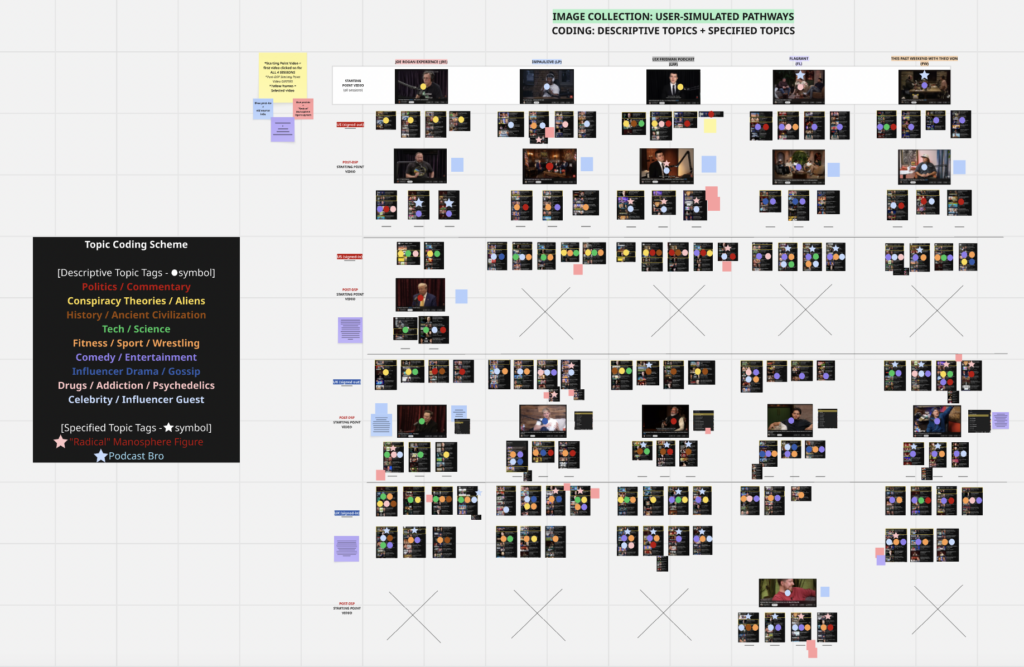
The study employs ethnographic walkthroughs to simulate user pathways on YouTube, mapping recommended videos across five popular podcast channels. These pathways are visualised in an image collection, coded by topic, and qualitatively analysed to identify when and how manosphere-related content emerges. By examining podcast bros as both cultural producers and algorithmic entry points, this research contributes to ongoing discourse on algorithmic radicalisation and the socio-political influence of YouTube as a site where ideology and infrastructure converge, specifically where the latter forms a digital ecosystem that facilitates the former.